Previous Article
"Hashiba"
Learn About the History and Culture of Kokushu



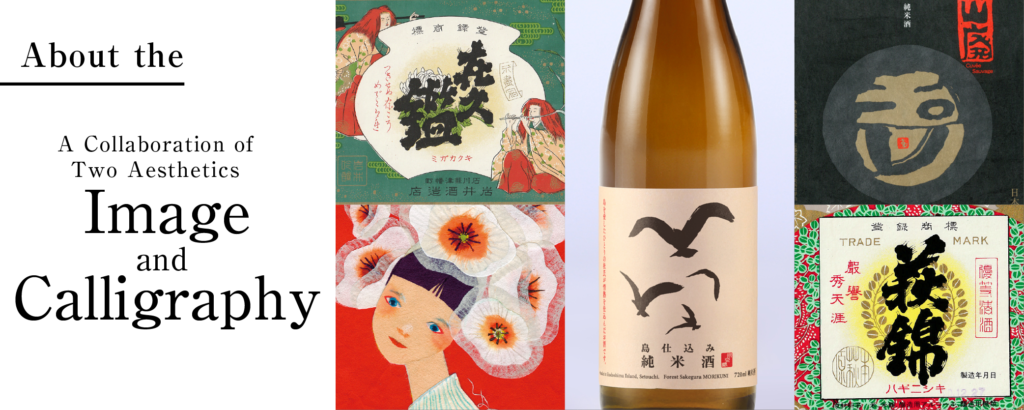
During the Edo period, sake was transported in large yon-to barrels that could contain 72 liters of sake. What we now recognize as labels did not yet exist. Instead, a brewery’s name was printed directly onto straw mats wrapped around the barrels using stencils. This practice survives today in the form of komo-kaburi—straw-wrapped sake barrels prepared for ceremonial and celebratory occasions.
The practice of affixing woodblock-printed labels directly onto barrels, without straw wrapping, is believed to have emerged around the fourth or fifth year of the Meiji period (1871 or 1872), particularly in connection with sake shipments from Yokkaichi Port in Mie Prefecture to Tokyo. This is my own hypothesis based on an analysis of the publication dates and regional distribution of extant labels.
Early labels were restrained in appearance, typically printed in one or two colors. They soon evolved into vivid multicolor designs employing bold reds and blues. Auspicious motifs—cherry blossoms, chrysanthemums, cranes, turtles, the “pine, bamboo, plum” trio—were commonly depicted, alongside dynamically expressive hige-moji (“bearded letters”), a distinctive style of calligraphy. Resembling ukiyo-e woodblock prints, these labels lent a striking visual presence to the barrels they adorned.
Compared with stenciled straw-wrapped barrels, woodblock print labels offered richer colors and eliminated the labor required for wrapping. This innovation may have emerged from brewers in Mie Prefecture, who sought to establish a foothold in the Tokyo market by capitalizing on their closer proximity to that market than brewers in the Nada region.
The use of woodblock print labels spread to breweries in the Kanto region and beyond, but gradually declined when mechanical printing techniques, including lithography and zinc plate printing, were introduced during the period of rapid Westernization. Unlike woodblock printing, these methods did not rely on specialized carving or printing craftsmanship. Printing houses soon appeared across Japan, and mechanically printed labels became widespread.
In the 1890s, the introduction of the issho-bin (1.8-liter glass bottle) brought further change. Valued for its lightness and convenience, it was quickly adopted by major breweries, prompting a reduction in label size. Labels that had once measured up to 25 centimeters in width on barrels were reduced to approximately 15 centimeters, with their surface area shrinking to one-third. When displayed on shelves, only a narrow portion of approximately 10 centimeters remained visible.
In this narrowed visual space, how could a brand stand out? Designers responded by simplifying imagery and emphasizing the brand name by framing it. In the label for Dokuritsu Otokoyama, for example, the name is enclosed within a circular frame, and Fuji no Eda in a square one, drawing the viewer’s eye through a clear “framing effect.”
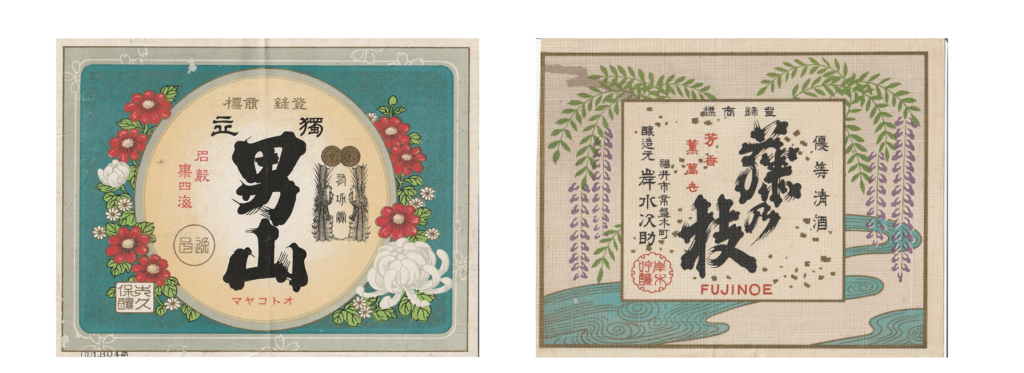
This design approach became widespread from the Taisho period through the early Showa era in the early to mid 1900s and reached a refined form in the postwar decades of the 1950s and 1960s. The combination of distinctive frames and design motifs inspired by each sake name during this period created what could be called a “Showa Classic” style — labels characterized by elegance, balance, and a touch of subtle playfulness.
Viewed collectively, sake labels reveal a collaboration between two distinct yet complementary forms of beauty: refined pictorial design and powerful calligraphy. In woodblock print labels, traditional aesthetic sensibilities were expressed through multicolor printing and ukiyo-e-inspired gradation. At their center appears an artistic calligraphic style of hige-moji.
Though created for commercial purposes, sake labels are also works of art in which image and calligraphy converge. The aesthetic DNA they embody has been passed down through time, continuing to express a uniquely Japanese visual identity.
Nobuo Ishida
Professor Emeritus, Hijiyama University